For investors, one bad quarter can be explained. Ten consecutive quarters are a pattern.
From the first quarter of 2024 through the second quarter of 2026, Fathom Holdings reported approximately $56.3 million in cumulative GAAP net losses. During that same period, its cash balance moved up and down as the company sold assets, raised equity and borrowed additional money. Yet Fathom ended June 30, 2026 with just $4.48 million in cash and cash equivalents, while the debt reported on its balance sheet had climbed to approximately $8.23 million. Fathom’s latest SEC filing states that recurring operating losses, limited liquidity and debt obligations raise substantial doubt about the company’s ability to continue as a going concern absent additional financial support.
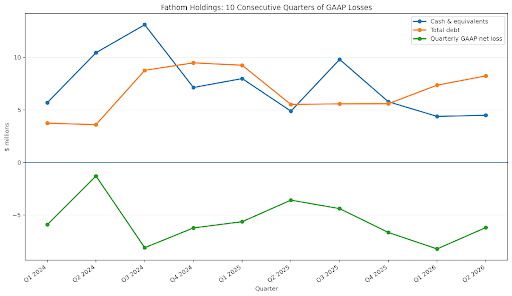
Image Source: Fathom Holdings SEC filings. Quarterly losses are shown below zero. Cash represents cash and cash equivalents. Debt reflects reported corporate borrowings and excludes mortgage warehouse facilities used in the ordinary course of the mortgage business.
The chart tells a compelling story. Quarter after quarter, losses continued while cash remained constrained. Even after receiving bridge financing from Bed Bath & Beyond in connection with its pending acquisition, the company’s underlying financial profile remained largely unchanged.
Ten quarters of losses
Fathom reported losses of approximately $5.9 million, $1.3 million, $8.1 million and $6.2 million during 2024. The trend continued through 2025 with quarterly losses of approximately $5.6 million, $3.6 million, $4.4 million and $6.7 million. The first half of 2026 added another $14.4 million in losses.
In total, shareholders have watched more than $56 million of shareholder value disappear over the past ten quarters. Public companies can certainly lose money while building long-term value. But eventually investors begin asking a different question: When does a temporary setback become a business model?
Bed Bath & Beyond has provided support—but questions remain
The proposed acquisition by Bed Bath & Beyond offers Fathom a potential path forward. The buyer has already provided bridge financing and committed additional financial support in connection with the pending transaction. That support is meaningful. But it has not changed the numbers reported in Fathom’s financial statements.
At June 30, the company still reported only about $4.5 million of cash, another quarterly loss, and continued to disclose substantial doubt regarding its ability to continue as a going concern without additional financial support.
One additional question deserves consideration. Can they afford the merger? Public company mergers are expensive. They generate millions of dollars in legal fees, accounting expenses, investment banking fees, SEC compliance costs, proxy solicitation expenses, communications costs and integration planning long before the transaction ever closes.
Does Fathom have sufficient cash to fund both its ongoing operations and its share of the costs required to complete the acquisition?
Compass entered its transformative acquisition with hundreds of millions of dollars in cash. Real entered its merger with RE/MAX from a position of financial strength, substantial liquidity and no debt. Fathom, by contrast, reported approximately $4.5 million in cash while continuing to report operating losses.
The answer may ultimately depend upon the terms of the merger agreement and any financial support being provided by Bed Bath & Beyond. But from an investor’s perspective, it is a reasonable question. When a company has disclosed recurring losses, limited liquidity and going-concern uncertainty, understanding how it intends to finance the closing of a complex public-company acquisition becomes part of evaluating the transaction itself.
Compare that with Compass
Every brokerage has experienced the same housing market. Compass has chosen a different financial trajectory. Following its acquisition of Anywhere, Compass reported billions in quarterly revenue, positive GAAP earnings, strong operating cash flow and hundreds of millions of dollars of cash on its balance sheet. Investors are evaluating integration strategy, operating leverage and future growth—not whether the company has enough liquidity to continue operating.
That is a fundamentally different conversation.
And then there is Real–RE/MAX
The Real Brokerage has likewise demonstrated a markedly different financial profile.
Real entered its merger with RE/MAX with substantial cash, no corporate debt and positive adjusted operating performance. While merger-related expenses affected reported earnings, investors are evaluating a company that is combining strength with strength.
RE/MAX has certainly faced its own business challenges. Franchise growth has slowed, revenues have softened and the company has been searching for greater scale. Yet the merger discussion has centered on strategic opportunity, not financial survival.
The contrast could not be more striking. Compass is talking about scale. Real is talking about growth. The combined Real–RE/MAX organization is talking about building one of the largest technology-enabled brokerages in North America.
Fathom is still talking about liquidity.
This is no longer just an investor story
There is another constituency that deserves attention. Fathom’s agents.
Thousands of talented real estate professionals have built successful businesses under the Fathom brand. They represent buyers and sellers every day with professionalism and integrity. Nothing in Fathom’s SEC filings suggests those agents are incapable of serving their clients.
But consumers are not hiring a stock ticker. They are hiring a brokerage. Many Fathom clients are encouraged to use affiliated mortgage, title and settlement services that operate under the same corporate umbrella. They are placing one of the largest financial transactions of their lives into an organization whose parent company has repeatedly disclosed recurring operating losses, constrained liquidity and going-concern uncertainty.
That naturally raises another important question.
Does fiduciary duty extend beyond the property?
Real estate agents owe their clients duties of loyalty, reasonable care and disclosure of material information related to the transaction. There is no universal rule requiring an agent to disclose the financial condition of the brokerage that employs them simply because that brokerage is publicly traded. But fiduciary responsibility has never been limited to checking regulatory boxes.
If an agent recommends affiliated mortgage, title or settlement services owned by a parent company that has publicly disclosed significant financial uncertainty, should that information become part of the consumer’s decision-making process? Would a reasonable buyer or seller consider the financial health of the organization handling multiple aspects of their transaction to be relevant? These are not accusations. They are questions. They are questions that brokerage executives, compliance officers, attorneys and regulators should be discussing before consumers begin asking them.

Ten quarters tell a story
Fathom may ultimately complete its acquisition by Bed Bath & Beyond. If it does, the combined company could emerge with far greater financial strength than Fathom has demonstrated on its own.
But history matters. Over ten consecutive quarters, Fathom lost more than $56 million. It entered the second half of 2026 with approximately $4.5 million in cash. Its public filings continue to discuss substantial doubt regarding its ability to continue as a going concern.
Meanwhile, Compass is generating profits and substantial cash flow. Real is expanding from a position of financial strength while acquiring RE/MAX.
Those are dramatically different stories. For investors, the distinction is measured in balance sheets and income statements. For Fathom agents, the distinction may be measured in something even more valuable.
Trust.