The MLS industry is being reshaped by private listing strategies, changing rules around cooperation and public marketing, questions about who controls and licenses real estate data, and the rapid rise of AI.
Against that backdrop, Daniel Jones of Hive MLS has created a new Declaration of MLS Stewardship Principles – and MLS Constitution – that defines the core tenets of an MLS and establish a framework around which MLSs could create a Federation.
This certainly will be a hot topic at the upcoming CMLS Open House at the end of this month.
In the story below, written by Daniel Jones, he explores the fundamental question behind them: What should an MLS be responsible for protecting as the marketplace changes around it? – Kevin Hawkins, Partner, WAV Group.
There was a keeper of a large field called Mendota Meadows. In the distance stood an old tree. The field was quiet then, with little more than grass between the few shops scattered across it.
Two merchants operated there independently: Robbie and Margot. Robbie’s customers brought him antiques, vases, candlesticks, and tapestries they wanted him to sell. He would valuate an item, display it in his shop, and receive a commission when it sold. On the other side of the field was Margot. She also sold antiques – large bedroom furniture, special chairs and couches, and beautiful hand-blown glass.
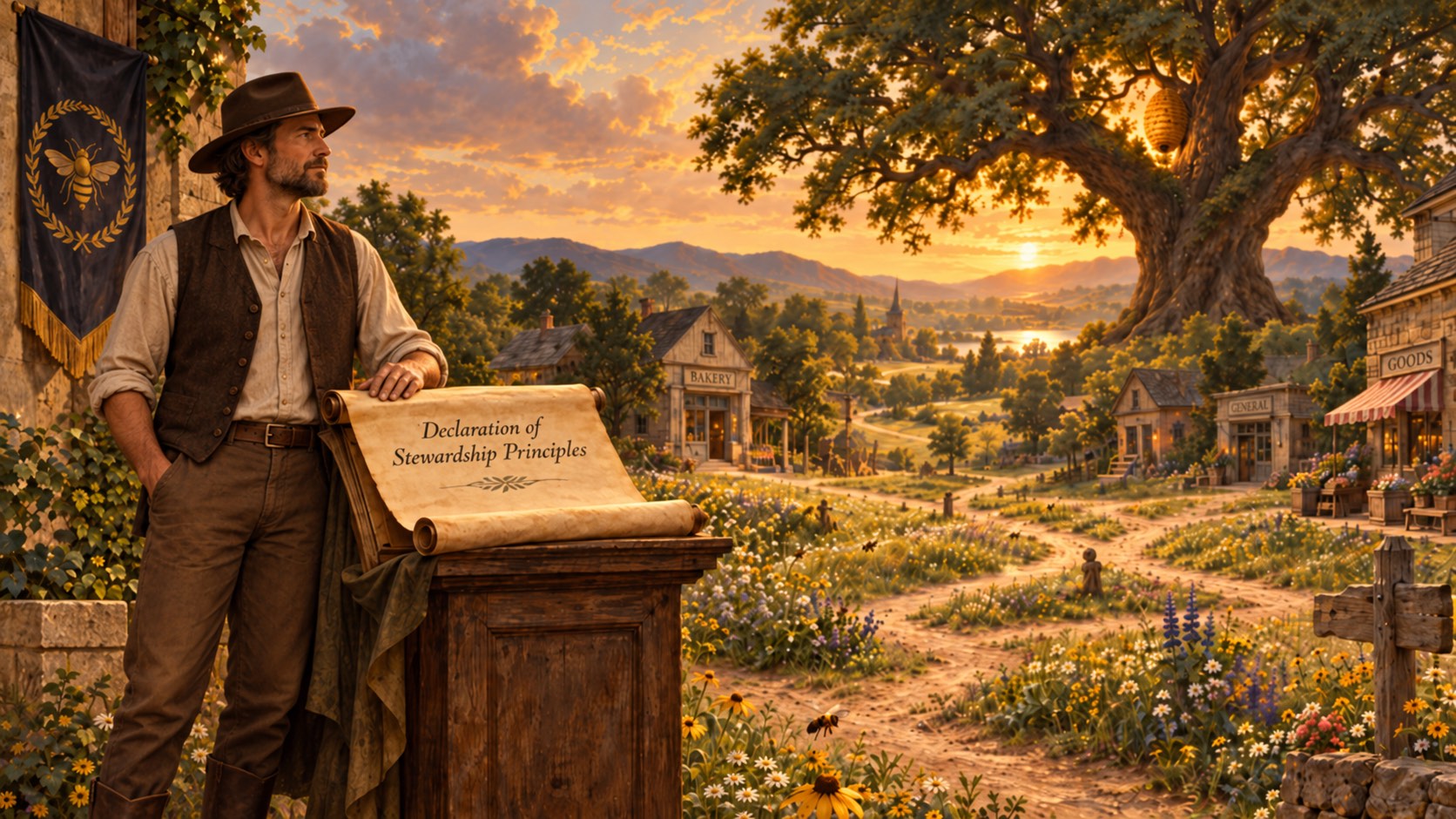
Robbie and Margot knew of one another, but they had struck no agreement to cooperate. Over time, though, they noticed people walking across the field from one shop to the other. So many made the journey that a path appeared in the grass. Elderly shoppers crossed it. Families with children crossed it. In wet weather there was mud, and in places the grass grew tall.
Robbie and Margot both recognized a need. They wanted customers from one shop to be able to reach the other more easily. So they approached the keeper and paid him to maintain the road.
More merchants came. More roads were created and eventually paved. Shops filled Mendota Meadows. The shopkeepers adorned the roads with flowers. As the roads multiplied, so did the flowers. Before long, bees began moving among them. The keeper noticed the bees from time to time, especially near the old tree in the distance, where a hive had taken hold.
A ledger everyone could trust
Soon Mendota Meadows was busy, and another problem appeared. Walking every road to every shop became wearisome. Shoppers were frustrated. So were the people who had consigned their belongings to the merchants.
The merchants needed a better way to understand what was available throughout Mendota Meadows. They approached the keeper and asked him to establish a common ledger. It needed to be maintained by someone they all trusted and, importantly, someone who was not a competitor in the marketplace.
At first, the ledger was simple: a picture, a description, a list price, and the merchant’s name. It was updated daily.
Now Robbie could be talking with a shopper. “You like the blue vase, I see.”
“Yes, but I’d rather have a red one. Just a little larger.”
“Well, I’m not one hundred percent sure on all the details, but I know there’s a red one at Margot’s Flair. Let me call Margot and put her on speakerphone.” And the transaction could be completed.
Margot liked what had happened. “Robbie, I’m going to start paying you two percent off my sales. Can we agree to do the same from here on?” And they did.
As Mendota Meadows grew, shoppers wanted more information. What were the dimensions of the vase? How old was it? Was it Blenko or Pilgrim Glass? The original ledger wasn’t enough anymore. So the merchants asked for more information to be included: dimensions, age, manufacturer, condition, and other characteristics necessary to understand what was being offered.
By this point, Margot had decided she wanted to cooperate with everyone in Mendota Meadows the same way she cooperated with Robbie. It was only fair, she thought, that everyone else do the same. The merchants asked the keeper to draft an agreement establishing how every shopkeeper participating in the field would cooperate, including expectations for timely and accurate authorship of the common ledger.
A new kind of shopper
Rand tried something different. Rand had someone working with his shop who would sit at the crossroads and approach shoppers. Instead of representing merchandise, this agent represented the shopper.
“Tell me what you’re looking for. I’ll use the ledger to curate a tour of all the Blenko glass available throughout Mendota Meadows. I’ll analyze the information, help you compare the pieces, and assist you in haggling over prices so you can make a fair deal.” In return, the shopper agreed that Rand’s agent would receive a piece of the transaction.
Now something else became important: the sold price. The list price told the merchants what someone hoped to receive. The sold price told them what happened. Sold prices became part of the ledger.
Eventually the field became a field of merchants, shoppers, agents of sellers, and agents of shoppers. The keeper ensured that the roads were maintained and that the ledger was honest. Honest did not necessarily mean forcing every hidden item into it. If an item was sold privately, the ledger could say so. The keeper did not force the marketplace to create a particular truth. He made sure the marketplace’s record told the truth.
Through experience, the keeper had also learned that what one merchant paid another merchant was not necessary for the ledger. That was their business.
When small challenges arose, the keeper developed a habit. He would walk toward the old tree and watch the bees move from flower to flower. He never announced what he was looking for there. He simply watched. And when he returned to meet with shopkeepers, he often happened to have a jar or two of honey with him.
New challenges were coming.
When the ledger left the field
Margot invested in a billboard just beyond Mendota Meadows. She boasted of the high number of transactions she’d completed and her access to the common ledger. She had also set up shops in other fields, as had many of the Mendota Meadows merchants. Naturally, she got calls.
Rand copied Margot’s efforts and put up a website that listed data from his own shop. A town hall was called.
“Let’s digitize the ledger,” the merchants proposed. “Let’s put the ledger online for potential shoppers. They shouldn’t even have to set foot in Mendota Meadows.”
The keeper agreed. He digitized the ledger and prepared its information for online use.
Rand proposed what it might look like online with a live prototype. Margot saw it and called him. “Rand, the display of the ledger is misleading. It looks like I’ve listed nothing and you’ve listed everything. And you’re putting data in there that is your opinion, to people that you don’t even know.”
Robbie copied Rand, and Margot copied Robbie. The only source of truth was the ledger, but the websites were getting unwieldy. They called another town hall. As usual, jars of honey sat ready on the tables.
“My sellers are trying to figure out who represents them,” Robbie said. “Is it Margot, or me? Because she’s got my stuff on her site, making it look like it’s hers to sell!”
Rand exclaimed, “Hold on, Robbie. Just hold it. When I search your site for blue Blenko vases, you’re telling people that the ones I sell are overpriced and not as nice as yours.”
Margot chimed in, “Half my inventory isn’t even on your sites!”
The keeper of Mendota Meadows was met with a conundrum. What was a keeper to do?
“I keep the field. Not the billboards.”
“I keep the ledger. Not the websites.”
But since he kept the ledger, he realized he had responsibilities concerning how that ledger left the field. The ledger brought value to Mendota Meadows and its community. If the community around the ledger eroded, eventually the ledger would erode with it.
So the merchants gathered and established among themselves standards for how information from their common ledger could be displayed when used as a marketing tool.
That night the keeper looked across Mendota Meadows. Shop lights illuminated the roads. Streetlamps glowed. The activity continued throughout the field, and bees settled on the flowers lining the roads. A thought came to him.
The field is going to be forgotten, but it will always be here. Our world is going to change.
And change it did.
Everyone had “a way”
Digital newspapers came online, and the shopkeepers permitted the keeper to distribute the details of their items to these enterprises. The Glossy Gazette and the Global Wire became national syndicates, gathering ledgers from many fields.
Margot’s website became successful. A powerhouse. Robbie had a shop in nearly every field known across the nation. Rand stayed in Mendota Meadows, loyal to the locals.
Everyone had “a way” of doing things. Margot turned her shops into petting zoos of dogs. Robbie had a charity slant in that a piece of every sale went to the impoverished. Rand’s shop had floors that creaked to the weight of his customers and smelled of history. A nice cup of coffee and a warm handshake.
The keeper was kind of forgotten. He provided a digital interface through which the shops could update their ledgers, and the keeper’s workers didn’t exactly know the history of Mendota Meadows. They knew compliance. They knew rules. They knew the software. They even befriended some of the shopkeepers’ agents.
Their legacies remained, but the history became muddled. At town halls, the keeper’s workers still placed jars of honey on the tables. Few remembered exactly why.
Meanwhile, the Glossy Gazette solicited Margot’s, Rand’s, and Robbie’s agents. “We will sell you leads to your listings.”
“Yes,” they said.
“We will promote your personal profiles on our site.”
“Ooh la la!” they said.
The Glossy Gazette tapped into what it did best: Marketing.
Eventually, a Participant Agreement was signed between Mendota Meadows and the Glossy Gazette. But no building was built.
The private ledgers
Margot joined forces with several friends in the field and built a better website. She said some of her sellers didn’t want their items in the common ledger. She created a ledger of her own. Robbie did the same. Dolly did the same.
The keeper didn’t involve himself in those private ledgers or the accuracy or completeness thereof. They weren’t his ledgers.
Rand, however, was hurt when his buyers looked for Blenko glass. Buyers who were committed to him began to question that commitment. One buyer asked, “Why should I have a buyer agreement with someone who doesn’t even know what’s in this field?”
Rand went to the keeper. “Keeper, what exactly are you keeping?” Before the keeper could answer, Margot approached. “I think I can answer part of that,” she said.
Margot explained that she hadn’t always entered her items into the general ledger timely. “My sellers wanted exclusivity. They didn’t want everyone touching their artifacts, and they didn’t want the others in this field involved in the sale. At least, not at first. They tend not to mind so much if this exclusive tradesmanship doesn’t work out.”
Rand listened. “So eventually,” Margot continued, “they change their minds. Then I put the item in the general ledger. Maybe with a new list price.” She looked at the keeper. “But nobody needs to know that I had it tucked aside for private viewing. Nobody needs to know its history. Nobody needs to know what the original price was.”
What belongs in the common ledger?
The keeper thought about this. “The ledger belongs to you all as shopkeepers in the field,” he said. “What you decide to market to the public is up to you.”
Margot smiled. “But,” the keeper continued, “I think you’re asking me two different things.”
Margot’s smile disappeared.
“If your seller doesn’t want to enter an artifact into the cooperative marketplace, that’s their choice. It’s their artifact. You represent them. You and your seller can decide what you want to do outside Mendota Meadows. I don’t keep your private ledger.”
“Exactly,” Margot said.
“But that’s not the second thing you’re asking me.” Rand leaned forward. “You’re asking that when you eventually bring the artifact into our common ledger, the ledger should forget what happened before it arrived.”
Margot shook her head. “How can your ledger forget something it never knew?”
The keeper stopped. That was a fair question.
“It wasn’t in your marketplace,” Margot continued. “It was in mine. What business is that of yours?”
Rand stepped in. “Because now you’re asking me to advise my shopper about it.”
Margot turned toward him. “My seller entrusted that artifact to me, Rand. Not you. You’re turning my seller’s private decisions into communal property.”
“No,” Rand replied. “Your seller’s private decisions are their business. But my shopper is now asking me what your vase is worth. If you tried to sell it privately for ten thousand, couldn’t sell it, and then put it in our ledger six months later for seventy-five hundred, that tells me something.”
“It tells you something that happened outside this marketplace.”
“It tells me something about the artifact I’m being asked to help someone buy.”
The keeper could see where this was going. Margot wasn’t wrong. Neither was Rand.
What does the marketplace need to know?
The keeper thought about the ledger. A long time ago, it contained little more than a picture, a description, a price, and the name of the shopkeeper. Then shoppers needed dimensions. Then they needed to know whether something was Blenko or Pilgrim Glass. Then they needed age. Then condition. Eventually the shopkeepers discovered that list prices weren’t enough. They needed sold prices because what someone asked for something and what someone actually paid for it were different pieces of information.
The ledger had grown because the marketplace needed it to grow. But surely that didn’t mean the ledger was entitled to know everything.
Suppose Margot showed a vase privately to three longtime customers before placing it in the ledger. Was that important? Suppose she had merely mentioned to someone that she might be getting a vase next month. Did that belong in the ledger? Surely not.
But suppose she had actively offered that vase for ten thousand for six months and found no buyer. Was that different?
The keeper realized he couldn’t answer the question simply by asking whether the information existed. The question was whether the information was material to the functioning of the common marketplace.
It’s our ledger
He looked at Margot and Rand. “I don’t think either of you gets to decide this alone.”
Margot crossed her arms. “It’s my seller.”
“Yes.”
Rand interrupted. “And it’s my shopper.”
“Yes.”
“And it’s your ledger,” Margot said.
The keeper shook his head. “No. That’s what I think we’ve forgotten.” He looked around Mendota Meadows. “It’s our ledger.”
There was a silence.
“You shopkeepers created it because none of you could maintain the marketplace’s information alone. You entrusted me to keep it because none of you wanted your competitor controlling it.” He looked at Margot. “I don’t get to tell you how to market your seller’s artifact.” Then at Rand. “And you don’t automatically have a right to everything Margot or her seller has ever known or done.” Then back toward the field. “But when information becomes necessary for this ledger to give the people who rely upon it an honest understanding of this marketplace, that’s different.”
Margot asked the obvious question. “Who decides what’s necessary?”
The keeper looked back at her. “We do.”
“All of us?”
“All of you.”
He thought for another moment. “And I suppose that’s what I’m keeping.”
What the keeper keeps
Rand looked puzzled. “The ledger?”
“No.”
“The field?”
The keeper shook his head. “Neither, exactly.”
He looked down the old road between Robbie’s shop and Margot’s Flair – the road that had started as nothing more than worn grass from shoppers walking between two competitors.
“I’m keeping the conditions that let you compete with one another while still cooperating with one another.”
The keeper walked for a while after the town hall had ended. The roads of Mendota Meadows were different now. The shops were different. The ledger had changed beyond anything Robbie and Margot could have imagined when they first asked him to maintain that worn path through the grass.
But the original road was still there. Flowers grew along its edges. Two bees moved quietly among the blossoms. One settled onto a flower, then another. For a moment, they rested on the petals before moving on.
The keeper looked beyond them toward the old tree in the distance.
Somewhere among its branches was the hive.
Note: You can read the new Declaration of MLS Stewardship Principles here.