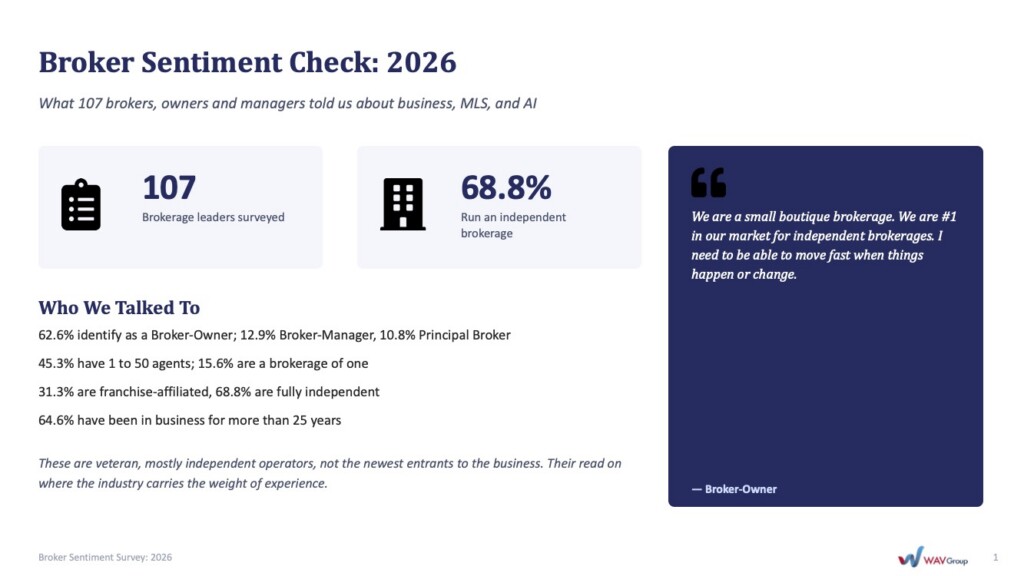
The WAV Group 2026 Broker Sentiment Survey set out to take the pulse of broker-owners, broker-managers, and principal brokers on the issues shaping their businesses today, from MLS satisfaction and AI adoption to brokerage consolidation and the long-term direction of the industry. The brokers who responded skew toward independent and experienced. Nearly 70% run independent brokerages rather than franchise operations, and almost two thirds have been in business for more than 25 years. This is a survey of seasoned operators, not newcomers, which makes their concerns about where the industry is headed worth paying attention to.
One of the more revealing sections of the survey asked brokers how worried they are about the long-term viability and future of the real estate industry as we know it. On a 10-point scale, the average worry rating came in at 5.88, with 14% of respondents landing in the most worried tier and just 6% in the least worried tier. That is a broker population that leans uneasy, and their own words explain why.
Why brokers are worried:
Lack of Professionalism
Professionalism, or the lack of it, came up more than any other theme. Brokers described a market flooded with part-time and low-production agents who they feel are dragging down the reputation of the whole industry. One respondent summed up the frustration this way, describing an industry that is “fragmented, fraught with too many rules and a very, very low bar to entry,” with too many “producers who don’t represent the best of the industry.” Another broker was even more direct about who is affecting the bottom line, pointing to “way too many non professional, below average agents” who “sell 2 or less houses a year” and “do not communicate well.”
Reduced Agent Value with AI
Technology and AI showed up as a second major thread, though brokers are split on what it means. Some see it eroding the role and the paycheck of the individual agent over time. One broker put it plainly: “The value and role of the individual agent is being reduced by technology. Not a bad thing but a different thing. Eventually, the agent will be doing less work per transaction but for a reduced fee.” Others framed AI, low barriers to entry, and industry noise as parts of the same problem, with one respondent listing “the low bar to entry, AI, the nonsensical things agents post” all in the same breath.
Affordability
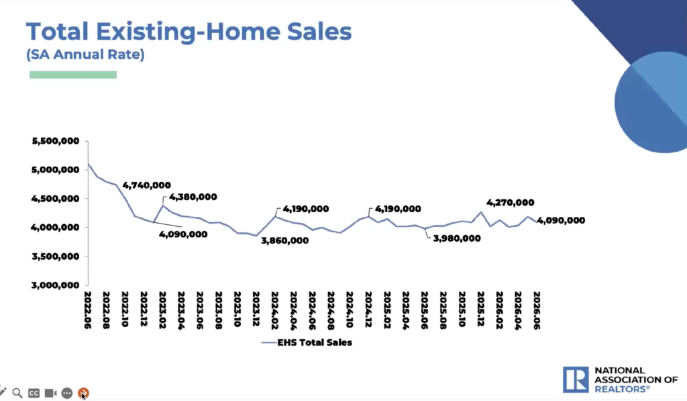
Affordability was the third major theme, and the data backs up what brokers are seeing on the ground. One broker pointed directly to “a generation of renters on our hands,” people priced out of buying altogether. That is not just anecdote. Annual existing home sales have leveled out at roughly 4 million, down from a longer run average closer to 6 million just a few years ago, as elevated mortgage rates and high prices keep would be buyers on the sidelines. Brokers feel that shift directly, since fewer transactions means fewer opportunities to do business, and several respondents connected the dots between affordability, shrinking transaction volume, and the long-term health of the industry.
Others suggested the industry needs to get more proactive about dealing with housing affordability with policy, programs and partnerships. “If sales volume is going to recover from a 4 million pace back toward historical norms, several brokers suggested, affordability has to be part of the industry’s own agenda, not just a market condition brokers wait out.”
What brokers would change:
Raise the Entry and License Maintenance Requirements
When asked what one thing they would change about the industry, raising the bar to enter the profession was the answer that came up again and again, and by a wide margin. Brokers want stricter licensing standards, more education, and more accountability before someone can call themselves a real estate professional. Several were specific about it. “Raise the bar for anyone to obtain a license,” one wrote. “Require higher fees, more education, more vetting.” Another respondent proposed going even further: “I think it should be a 2 year degree requirement before you can get licensed.”
Production standards came up almost as often, with brokers suggesting minimum transaction counts to keep a license active rather than letting occasional, part-time agents represent the profession. “Higher barrier to entry for agents first,” one broker wrote. “There are too many agents and the majority only complete 1-4 transactions a year.”
Stricter Accountability Standards
Some brokers want more accountability and teeth in the methods for removing disreputable or incompetent practitioners. “More focus on the consumer, less focus on us,” one broker offered, a sentiment echoed by others who wanted stronger enforcement against agents who mislead or fail to disclose to clients.
Stronger Advocacy
Some brokers also pointed squarely at NAR itself, calling for stronger advocacy, less friction with MLSs, or in a few cases a reversal of the compensation rules the association put in place.
The counterpoint: confidence in their own brokerage.
Despite all of that industry-level unease, brokers are considerably more optimistic when the question turns inward. Asked to rate their optimism about the long-term viability of their own brokerage, the average came in at 7.00, a full 1.12 points higher than their industry-wide worry score, with 25% of respondents landing in the most optimistic tier and only 3% in the least optimistic tier.
That confidence shows up in how brokers talk about their own businesses. One broker, describing over a decade holding the top market share position in a small community, put it simply: larger brokerages have tried to acquire them, and they have resisted every time. Others pointed to their boutique positioning, deep local relationships, and personalized service as the reason they expect to come through whatever happens at the industry level intact.
The pattern that emerges from this survey is a broker population, mostly independent and mostly veteran, that sees real structural problems ahead for the industry, tied to professionalism, technology, and affordability, but that largely trusts its own ability to navigate them. Whether that confidence holds may depend on how quickly the industry addresses the concerns brokers raised most often: who gets to call themselves a professional, what it takes to keep that title, and whether buyers can afford to walk through the door in the first place.