Worried about your Association’s value proposition? Many REALTORS® don’t understand everything their Association does for them and frankly, many don’t care. There IS one benefit every real estate professional can appreciate: Knowing their Association is actively working to keep them safe.
Imagine if every REALTOR® knew their Association was helping them avoid dangerous situations, providing tools to protect them when something goes wrong, and teaching practical ways to keep their clients and families safe, too. That’s an Association value proposition that’s personal, tangible, and hard to ignore.
 Learn How Two Associations are making Safety a Priority Year Round
Want to hear how Associations are turning agent safety into a meaningful member benefit by focusing on safety year-round with technology, on-going education and constant focus?
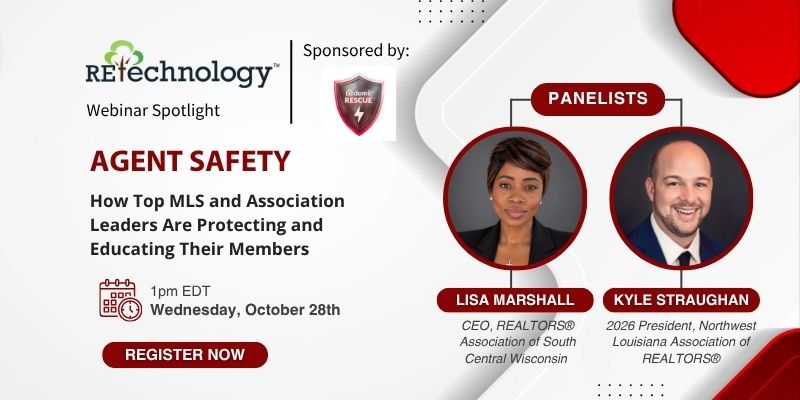
Join me Wednesday, October 28, at 1:00 p.m. Eastern for RETechnology’s The Safety Secret webinar, sponsored by Domii Rescue.
We’ll hear from Lisa Marshall, CEO of the REALTORS® Association of South Central Wisconsin and South Central Wisconsin MLS, and Kyle Straughan, Broker and President of the Northwest Louisiana Association of REALTORS®, about practical ways to make agent safety a more visible, valuable part of the Association experience.
Register for The Safety Secret webinar
10 Ways Associations Can Teach and Reinforce Agent Safety
While REALTOR® Safety Month is a good start, it’s simply not enough. Associations have an opportunity to make member safety a year-round priority through ongoing education, encouraging participation in safety training and certification programs, partnering with brokers to reinforce safe practices, and providing practical technologies that help agents protect themselves before, during, and after a real estate transaction.
Here are ten ways every Association can turn that commitment into action.
- Offer Safety Education EVERY Month, Not Just in September
Keep safety top of mind with monthly training opportunities, regular safety articles, practical reminders, and access to technologies that help agents stay safe. Celebrate members who regularly participate in safety education or earn safety certifications. Make safety something your Association talks about and actively supports all year long.
Our sister company, RETechnology offers an extensive collection of FREE agent safety articles by Lee Goldstein, behavioral criminologist. His articles explore how predators select agents, safe showing practices, identity verification, and ways to prevent dangerous encounters. Associations can draw on these insights for ongoing member communications, newsletters, and safety training programs.
Explore Lee Goldstein’s FREE agent safety articles on RETechnology
- Teach Members to Make Safety a Habit in Their Sales Process
Safety should be as routine as scheduling a showing or preparing a listing presentation. Teach agents to establish simple procedures before every appointment, including verifying who they are meeting, choosing safe meeting locations, and having a plan if something feels wrong.
- Teach Members to Use Background Checks, but Understand Their Limitations
Background screening tools can help agents make more informed decisions before meeting someone unfamiliar. But here’s a significant limitation that agents need to understand: Some commonly used screening tools rely on phone numbers to identify individuals and retrieve background information.
Someone with a criminal history who has something to hide may simply change their phone number or use a different number. If the screening tool cannot connect that number to the person’s actual identity, their criminal history may never appear in the results. A clean report could create a false sense of security. Teach members to understand the limitations of the technology they’re using and to combine screening with independent identity verification and other safety precautions.
- Help Members Establish a Reliable Emergency Contact Network
Every agent should identify trusted people who can respond quickly if something goes wrong. Encourage members to establish emergency contacts, create a check-in protocol, and make sure those contacts know what to do if an agent signals distress or misses a scheduled check-in.
- Teach Members to Share Their Locations and Appointment Details
Before entering a property, agents should share their location, appointment details, and expected return time with a colleague or trusted contact. Associations can introduce location-sharing technologies that make this process easier and help emergency responders find an agent when every second counts.
- Teach Members to Verify and Document Who They’re Meeting
Encourage agents to verify identities and, when appropriate, document vehicle descriptions or license plates. Photographs of identification can also be useful when collected with permission and stored securely in accordance with applicable privacy laws. Teach agents how to establish accountability without creating unnecessary privacy risks.
- Make Annual Safety Training and Certification an Attractive Member Benefit
Offer comprehensive safety education each year and encourage members to participate in training or certification programs that build their confidence and practical skills. Cover situational awareness, open-house safety, warning signs, emergency response, and safe use of technology. Make training convenient and affordable, recognize those who complete it, and introduce safety education during new-member orientation.
- Partner With Brokers to Reinforce Safety Training and Practices
Associations can’t do this alone. Encourage brokers to establish consistent office safety policies, train their agents, and practice emergency procedures. Associations can provide training materials, speakers, checklists, and technology resources that brokers can integrate into their operations. Make it easy for brokerages of every size to establish effective safety practices.
- Encourage Members to Share Safety Practices and Tools With Clients and Families
Safety shouldn’t stop with the agent. Teach REALTORS® how to share appropriate safety practices and app-based tools with family members, colleagues, and clients. Clients can also benefit from understanding identity verification, safe showing procedures, and precautions when allowing strangers into their homes. Imagine the goodwill an Association could build by helping its members protect the people they care about most.
- Reinforce the Importance of Trust, but Verify
Real estate is a relationship business, and REALTORS® are naturally inclined to trust people. But being friendly and professional doesn’t mean ignoring warning signs. Teach agents to verify identities, question unusual requests, recognize warning signs, and leave immediately if they feel uncomfortable. Reinforce one simple message in every safety training program: No commission is worth risking your personal safety.
Turn Safety Into a Benefit Members Can See and Feel
Your Association may help members build better businesses. It can also help make sure they return home safely to the people who love them. That’s a value proposition worth investing in.