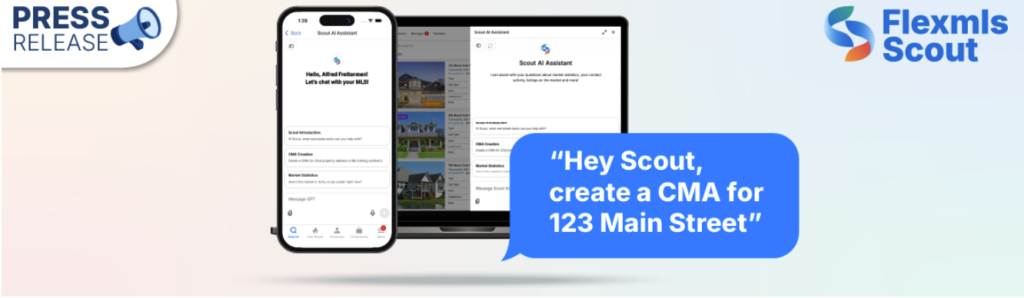
Flexmls is now AI enabled. On November 4, FBS released Flexmls Scout, a conversational AI assistant built directly into the Flexmls platform on desktop and mobile. That is the headline.
The story is bigger. Real estate agents are already using AI to shape MLS records around the needs of their clients. They pull listings, re-cut market statistics, draft CMAs, and turn raw data into advice a buyer or seller can act on. Until this week, most of that work happened outside the MLS, in a ChatGPT or Claude window the MLS could not see and did not govern. Scout moves the prompt inside the system of record.
That is a strategic shift, not a feature release. Whoever hosts the prompt hosts the workflow. FBS just made a clear bet that the MLS should be that host.
Phase One: Open the Door With MCP
The first phase of the FBS AI strategy was the Flexmls MCP Server. MCP, the Model Context Protocol, lets an authenticated agent connect the AI tool of their choice, whether ChatGPT, Claude, or something else, directly to MLS records. The agent asks a question in their own AI, and the AI reaches into Flexmls for the answer.
This was the right first move. It acknowledged reality: agents had already chosen their AI, and the MLS could either connect to it or be routed around. MCP gave the MLS a sanctioned, permissioned pipe instead of a screen-scrape or a copy-and-paste.
But MCP has a ceiling on adoption. It asks the agent to own the setup. They need a paid AI subscription, they need to configure a connector, and they need to trust that the whole chain works. Early adopters will do that. The broad middle of the membership will not. MCP is infrastructure for the power user and for the developer. It is not, by itself, how a 30,000-member MLS changes behavior.
FBS also shipped Auto Assistant+, which applies AI to listing entry. That matters, because it puts AI on the input side of the record, not just the output side. Taken together, these two releases laid the groundwork for what came this week.
Phase Two: Put the Prompt Where the Agent Already Works
Scout is the second phase, and frankly it is the one most likely to drive agent adoption. Agents do not need to bring their own AI, configure anything, or leave the application. They open Flexmls on their desktop or phone and ask.
FBS lists the core jobs: search listings, surface market statistics, access contact and production details, assist with CMAs, and clarify MLS rules and policies. The sample prompts are telling in their ordinariness:
- “What was the median sales price in my market last month?”
- “Create a CMA for 123 Main Street.”
- “What are the MLS rules around Coming Soon listings?”
None of these are exotic. That is the point. Agents and appraisers already know how to prompt AI. They have been doing it for three years. What Scout changes is where those prompts live. The question that used to be typed into a consumer chatbot, with MLS data pasted in by hand, is now asked inside the platform that owns the data.
The third example deserves a second look. An agent asking Scout about Coming Soon rules is getting the answer from the MLS itself, not from a general model that may be quoting a different market’s policy or a rule that changed two years ago. Rules compliance has always been an education problem. Scout turns it into a query.
FBS says Scout was developed through user research and beta partnerships with Flexmls MLS customers, and that the beta confirmed it fit naturally into how active users already work. It is sold to MLSs as an enterprise solution, which means the MLS, not the individual agent, decides to turn it on.
A Better Environment for Security and Guardrails
Every MLS executive I speak with has the same quiet worry. Agents are pasting listing data, contact records, and confidential remarks into consumer AI tools, and nobody knows where that data goes next. The MLS licenses its data under specific terms. A browser tab does not read license agreements.
Scout addresses that directly. It runs inside the existing Flexmls security and permissions framework, so a user sees only what they are already authorized to see. The MLS keeps control over how its data is accessed and used under its licensing terms and policies. FBS states plainly that MLS data is not retained or used to train or retrain AI models.
That last commitment is the one boards should underline. The value of MLS data is its authority and its exclusivity. Data that leaks into a model’s training set loses both, permanently. Keeping the prompt inside the MLS keeps the data inside the license.
There is a second benefit that gets less attention. When AI work happens inside the MLS, the MLS can see it. It can learn which questions agents ask most, where its rules confuse people, and which data fields matter in practice. When that same work happens in an outside chatbot, the MLS learns nothing. Governance and insight come from the same place: being the host.
What This Means for the MLS and the Brokerage
For twenty years, the MLS has watched value migrate to the edges. Portals took the consumer. Broker and franchise platforms took the agent’s front-end workflow. The MLS was left as the database underneath, essential but invisible. AI threatened to finish that job. If the agent’s daily interface becomes a general-purpose chatbot, the MLS becomes a data feed to someone else’s product.
Scout pushes back on that drift. It puts a modern, conversational interface on top of the authoritative record and keeps the subscriber inside the MLS. Kim Prior, FBS vice president of Product, framed the roadmap as moving “from insight to engagement to action,” with the MLS at the center of the real estate workflow. If FBS delivers the action layer, Scout stops being a research tool and starts competing for the agent’s whole day.
For brokers, the profitability math is straightforward. Time an agent spends assembling a CMA or decoding a policy is time not spent with a client. An MLS-native assistant licensed at the MLS level lowers the cost of that work without adding another per-seat AI subscription to the brokerage’s tech stack. It also reduces the brokerage’s exposure when an agent mishandles data in an outside tool. Brokers should watch closely how far Scout reaches into contact and production data, because that is where the line between MLS utility and brokerage platform starts to blur.
One caution for everyone. An AI that generates CMAs inside the MLS carries the MLS’s credibility. When it is wrong, the error carries that credibility too. Accuracy, auditability, and clear human review are not optional features. They are the price of being the trusted source.
Strategic Recommendation for the MLS Board
Flexmls customers should treat Scout as a governance decision first and a technology decision second. The question is not whether your subscribers will use AI with MLS data. They already are. The question is whether that work happens inside your license or outside it.
- Make the call deliberately. Scout is an enterprise product the MLS turns on. Put it on the board agenda, not just the staff agenda, and decide on timing with eyes open.
- Write the AI policy before the rollout. Define acceptable use of MLS data in any AI tool, inside or outside the MLS. Scout is far easier to defend when the rules for outside tools are clear.
- Run both phases, not one. Keep the MCP Server available for power users and approved vendors. Push Scout to the broad membership. Different subscribers, different on-ramps, same governed data.
- Insist on transparency about accuracy. Ask FBS how Scout CMAs and rule answers are tested, how errors are reported, and what audit trail exists. Your brand is on every answer.
- Train for prompting, not clicking. The adoption barrier is no longer the software. It is habit. Fund short, practical training that shows agents the five questions Scout answers best. WAV Group’s AI Guy, Kevin Hawkins is a great resource for training MLS staff and customers.
- Measure the usage. Ask for reporting on what subscribers ask. Those prompts are the most honest member survey the MLS will ever get.
- Read this AI Cotality AI eBook – https://www.cotality.com/resources/res-ai-ebook
The MLS that hosts the prompt keeps the subscriber. The MLS that does not will find its data doing valuable work in someone else’s product.
WAV Group offers two popular services to MLSs today. We can help build out the MLSs AI strategy and governance. We can help with AI vendor selection. Contact Marilyn today for a confidential conversation and lets see if we can help.